A home printer is often selected by its purchase price even though later spending depends on quite different choices. Do you occasionally print a ticket, produce work documents every week or regularly print photographs? Do you need colour on paper or mainly readable text? Answer using recent months rather than the largest printing project you can imagine.
Count a representative number of printed pages. If you currently print elsewhere, use receipts or keep a short record. Separate text, colour documents and photographs. Also note whether documents should print on both sides. Sheets of paper and printed pages are different quantities in this calculation.
Read the package contents carefully
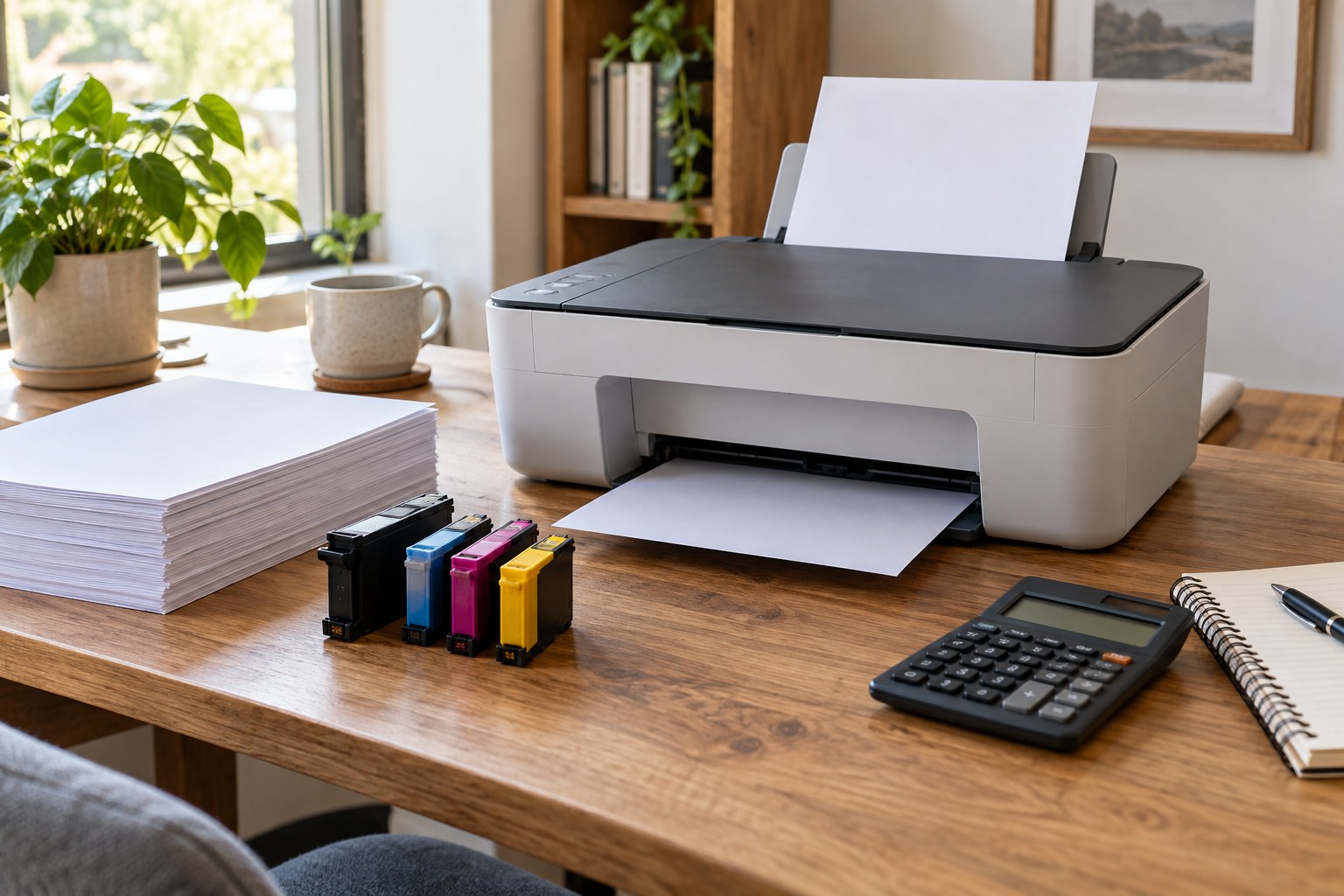
Check which ink or toner comes with the machine. Included starter supplies may be described differently from replacements sold later. Find the exact replacement references and check their current prices with your intended supplier. Do not base the calculation on an unusually large pack that you are unlikely to use.
For a rough comparison, divide a consumable's price by its stated page yield. That figure is a guide under test conditions. Epson explicitly explains that standardised yields cannot fully reproduce an individual's printing habits. Do not present the resulting figure as a guaranteed cost for photographs, drafts or infrequent print jobs.
Include other scheduled consumables where relevant to the model. Read maintenance information and identify how replacements are obtained. An inexpensive cartridge is less helpful when another routinely required component has been overlooked. Equally, there is no need to buy every possible spare in advance simply because it appears in an accessory catalogue.
Use two scenarios rather than false precision
Calculate both lower and higher usage. In an explicitly hypothetical example, printer A costs ninety dollars and printer B costs two hundred. If the assumed running-cost difference is four cents per page, it would take 2,750 pages to offset the additional 110 dollars. Paper, maintenance and other differences are not included. This illustrates the arithmetic rather than comparing real printer models.
The figure only helps when the timeframe is realistic. At a few pages per month, that volume might take many years to reach. Space, suitability for your workflow and occasional printing elsewhere may then matter more. With frequent lengthy documents, consumable spending can become significant much sooner. Avoid assigning the same expected volume to households with very different needs.
Check connectivity before purchase too. Will you print directly from a phone, from several computers or only through a cable? Confirm support for those devices and applications. A paid service or necessary additional cable belongs in the total. Assess an optional printing subscription separately, examining its allowance, treatment of unused pages and cancellation terms rather than treating the advertised monthly fee as a universal running cost.
Do not overlook the working space. Paper input, output and access to covers all need room. A machine that fits a shelf when closed may not be usable there. Measure the required operating area using the manufacturer's dimensions, including the positions in which trays and covers will be used.
The final choice should suit an ordinary printing week. Keep your assumptions and review actual use after the printer has been in service. Your next purchase can then be based on your own quantities instead of turning a stated page yield into an apparently exact promise of long-term savings. A clear range is more useful than a precise-looking total built on uncertain usage.