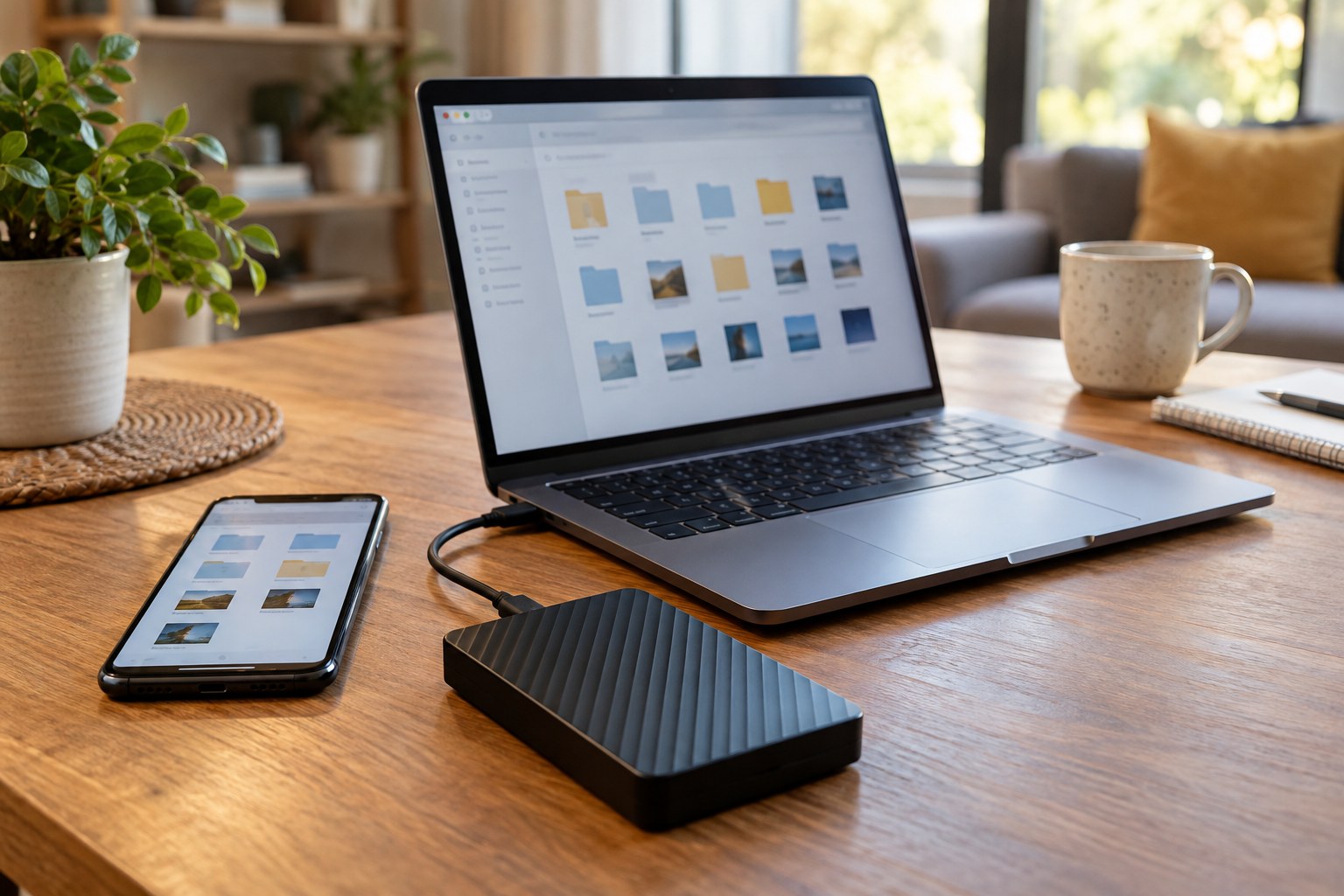
Several devices can gradually lead to several storage subscriptions. One package came with a phone, another was purchased for photographs and a third accompanied a work application. Before buying more capacity, take stock. For each account, record provider, purchased capacity, occupied space and payment.
Distinguish personally managed accounts from organisational accounts. Do not move work material into a personal service merely to use spare capacity. Check applicable requirements and permissions. Price comparison becomes useful only after establishing which data may be managed together and which functions are necessary.
Understand occupied space by purpose
Inspect what consumes the allowance. Photographs, videos, backups, email and shared files may have different needs. A large storage figure does not establish which content is duplicated or which automated processes depend on it. Record important data categories and devices rather than immediately deleting the largest files.
Check whether subscriptions perform the same job or simply have similar names. Synchronisation, backup and archiving are not automatically interchangeable. Treatment of edits and deletions is particularly important. A file appearing in several synchronised locations is not necessarily an independent additional backup. Understand the arrangement before treating a copy as redundant.
Compare more than gigabytes
Consider access, supported devices, sharing and important applications. Cheaper storage can be unsuitable if a necessary automatic process does not work there. Conversely, capacity already paid for may be enough if it is usable for that exact task. Test with a small, noncritical selection before a larger change.
Account for other authorised users too. Shared capacity does not always imply identical visibility of all files, and administration differs between services. Read the relevant information. A saving offers little value if important sharing arrangements become unclear or inappropriate afterwards.
Read the consequences before cancelling
Consult each provider about reducing a plan or cancelling. Google One, for example, describes cancellation consequences and the effects of the storage allowance then available. Use current instructions for your account instead of carrying assumptions over from another service. Do not end a plan before establishing what happens to needed data and functions.
Record the end of any prepaid period where the conditions identify it, and leave sufficient time. Large quantities can require substantial downloading, transfer and checking. The destination plan's price is therefore not the only relevant figure. The practical process must also fit your connection and devices.
Plan a verifiable migration
First make an appropriate independent backup of important material. Establish what should move and what must remain in the existing account. Use the designated export or download functions and note differences between original files, previews and metadata. For photographs, folder organisation and additional information may matter to how you use the collection later.
Transfer a manageable sample first and inspect it at the destination. Can the files be opened? Are formats and necessary details intact? Do important access methods work on the intended device? Seeing a filename alone does not prove that the complete usable file arrived. Pay particular attention to formats you use regularly.
Then move the larger collection in understandable stages. Record what has been completed and checked. Do not delete the original merely because a progress bar reached its end. Allow a transition until the new arrangement is verified and important backups exist. This may temporarily mean duplicate charges, but the overlap can be planned and bounded rather than continuing indefinitely.
Review the resulting capacity
Afterwards, compare real capacity needs with the chosen plan. Allow a reasonable margin for ordinary growth without automatically selecting the largest tier. A short observation period can test assumptions about photographs, documents and backups. Also check whether automatic uploads still feed an old account and recreate duplicate arrangements.
Only after these checks should you end unnecessary payments through the specified process and retain confirmations. Savings should emerge from a working data arrangement. A lower monthly charge is not a successful outcome if important content is missing or a necessary backup has quietly disappeared. Keep the final inventory with your account records so that the next device purchase does not restart the same accumulation of overlapping subscriptions.