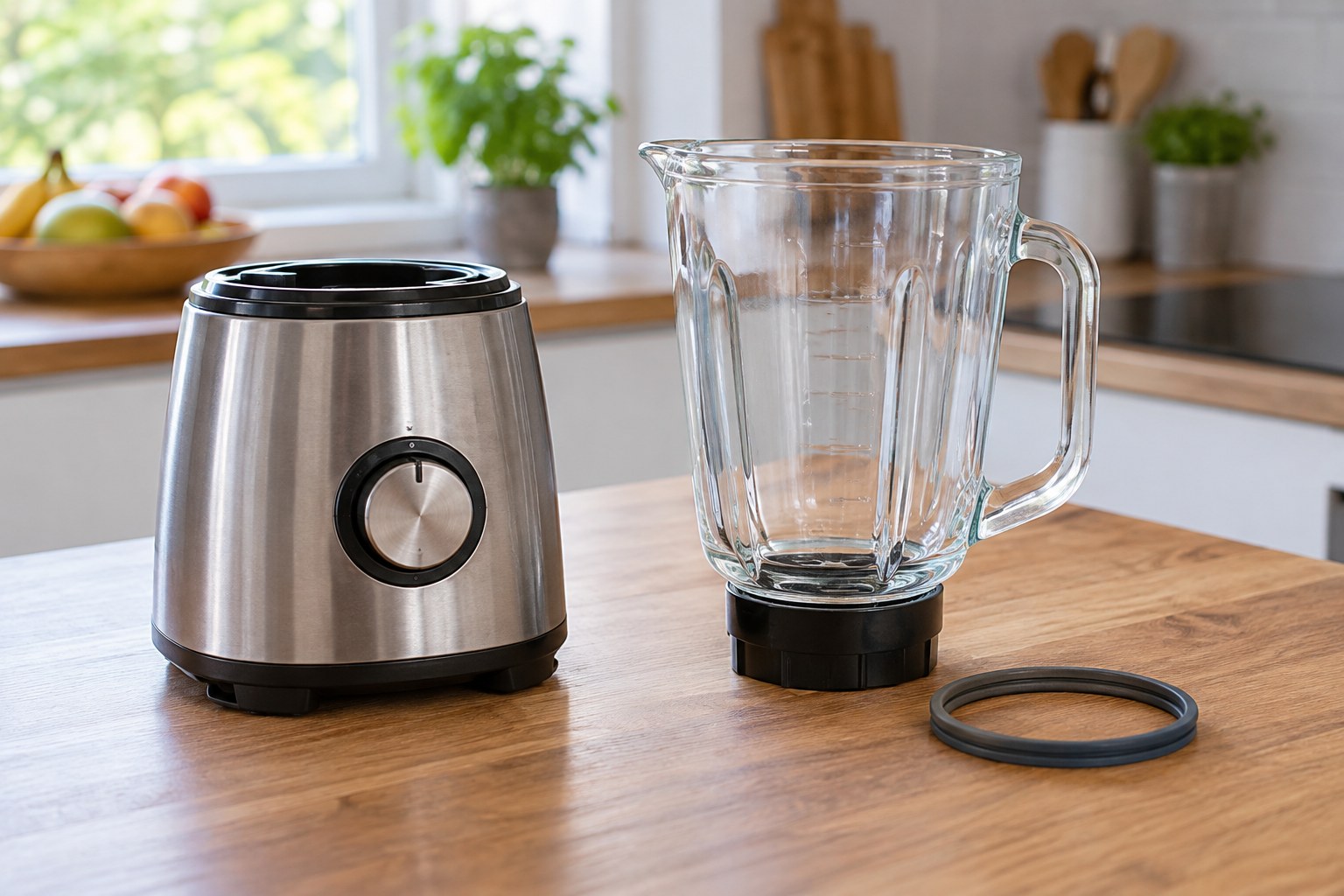
A damaged handle or missing container does not automatically require replacing an entire appliance. Identify the affected component and full model number before shopping for a new machine. Only then can you compare a spare part, service visit and replacement meaningfully.
Start with the correct identifier
Locate the rating plate as the manufacturer directs and photograph its details. A product-family name and colour are often insufficient for ordering. Bosch, for example, uses the appliance's E-number in its parts finder. Other manufacturers have their own identifiers. Include every required character so different versions are not confused.
Describe the issue factually: a particular container is missing, an external fitting is broken or a specified wear part is needed. Distinguish that from an unknown operating fault. An unusual sound does not reliably identify which internal component should be purchased. Buying a guessed part can add expense without resolving the problem.
Separate owner tasks from service work
Check whether the operating instructions explicitly allow the owner to perform the replacement. Availability of a spare part is not permission to open an electrical appliance arbitrarily. Unclear repairs, safety components and work beyond prescribed maintenance belong with an appropriate service provider.
For a quotation, ask what is included: diagnosis, component, labour, travel or shipping. Clarify what happens if examination reveals a different fault. This avoids comparing a complete new-appliance price against an incomplete repair figure. The useful comparison includes the work necessary to obtain a functioning appliance again.
Consider the condition you already know
Look beyond age and repair price. Does the machine still fulfil its intended job, and are there other known problems? A well-suited existing appliance may remain useful after a straightforward permitted parts replacement. A new component does not resolve already inadequate capacity or unsuitable handling.
Save the search result even if you do not order immediately. An unambiguous part identifier and written quotation make a later decision easier. Compare actual total expenditure and remaining usefulness without inventing a universal percentage threshold for every repair. Sometimes a small part is enough; sometimes a professionally informed replacement decision is more appropriate. The evidence should determine which situation applies.
Separate a missing component from an unknown fault
For a clearly missing accessory, the assessment can be limited: correct model, matching part number, complete cost and prescribed fitting. For an unknown fault, diagnosis is part of the service. Treat these situations separately even when both initially appear minor. An inexpensive component on a website does not prove it addresses the cause.
Ask the service provider what decision you can make after diagnosis and what costs remain payable if no repair is commissioned. Keep the answer in writing. This lets you choose an assessment deliberately without later confusing its cost with a simple parts order.
Then compare a new appliance performing the same job. Extra features may have personal value, but they are not a repair saving. Equally, an existing well-suited machine should not be rejected solely for its age. A reasoned decision combines the confirmed problem, complete expenditure and usefulness still required, rather than automatically favouring every repair or every replacement. That distinction is particularly useful when a small initial symptom leaves several possible explanations open.