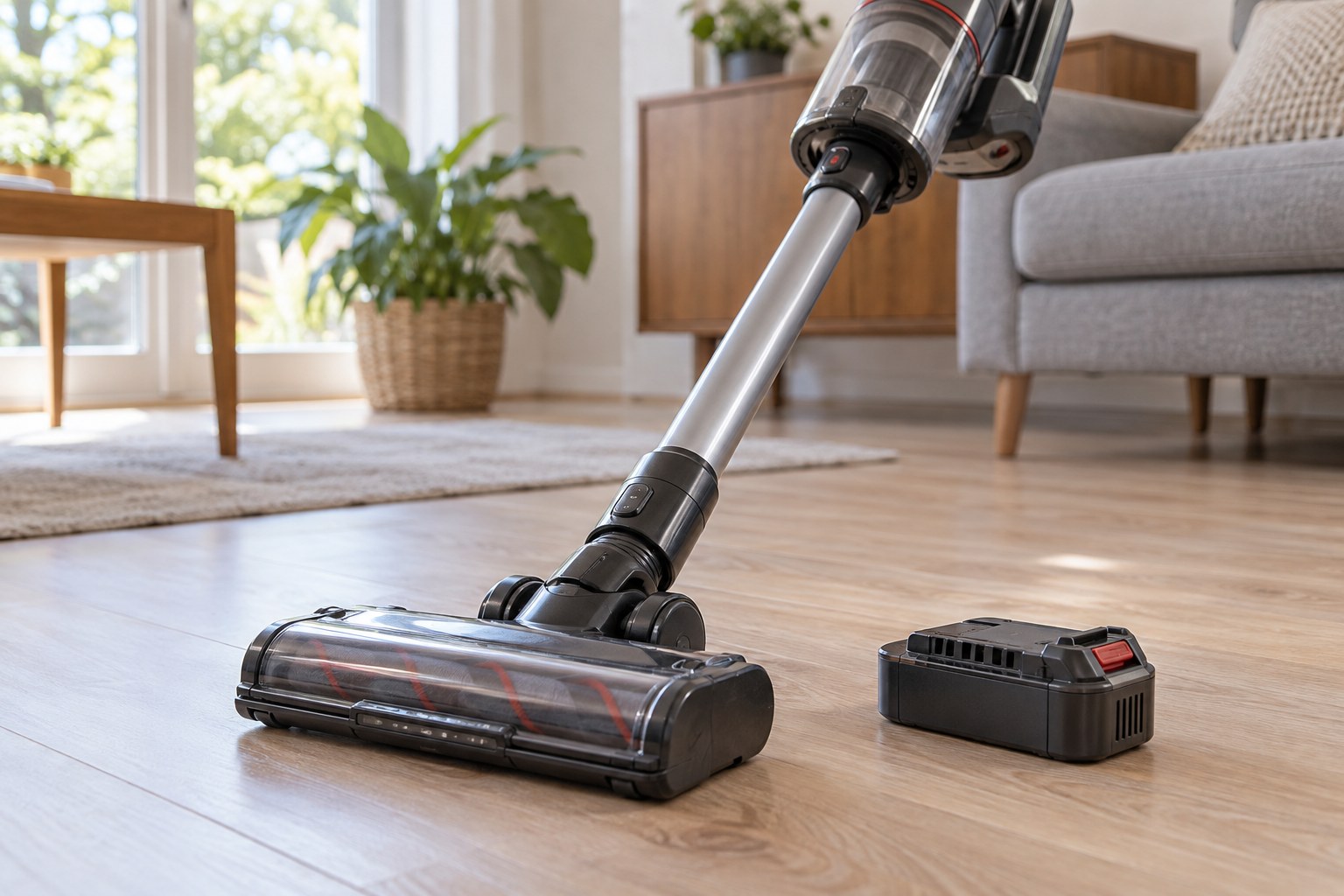
Cordless vacuum comparisons often focus on runtime. It also matters what happens when the battery no longer covers your normal cleaning session. Before purchase, establish whether a suitable replacement exists and how replacement is intended to work.
Relate runtime to your routine
Divide the home into the areas you normally clean in one session. A quick daily pass around the kitchen differs from cleaning several rooms with different floors. Maximum runtime claims may use particular settings and attachments. Compare the conditions behind those figures rather than simply choosing the largest number of minutes.
Consider whether you actually need the highest power setting throughout the session. Avoid setting a requirement around an imaginary whole-house routine that you never follow. If you would need a second battery, include its price, charging arrangements and storage in the original comparison. It is part of the proposed system, not a free solution to an insufficient first battery.
Replaceable does not mean available everywhere
Find the exact battery identifier in the manufacturer's parts information. Check whether the instructions describe an owner replacement or a service procedure. A component secured with screws is not automatically intended for home repair. The instructions for your particular model matter more than a video showing a similar-looking cleaner.
Check what a replacement purchase includes. Another battery does not necessarily come with another charging station. Confirm that the existing charger is explicitly suitable. Do not improvise adapters to connect an unrelated power-tool battery to the cleaner. The correct model and approved charging arrangement should be clear before any replacement is ordered.
Compare cost and handling together
Add a possible replacement battery as a separate ownership scenario alongside one without a replacement purchase. This shows its financial significance without pretending to know a precise service life. Current availability is useful but is not a promise covering many years. Save the appliance and part identifiers for later enquiries.
Where possible, handle a display cleaner and try the battery release if it is intended for users. An easily replaced battery does little to help if the cleaner itself is awkward to hold. A suitable choice combines enough usable runtime for your real cleaning session with a clear route to maintenance and replacement. That is more informative than runtime alone.
Separate two cleaning scenarios
A brief pass after dinner may be covered by one suitable battery. Cleaning several separate floors may make a charging interruption more relevant. Write out both routines with the actual areas involved and identify which occurs more often. Buy a second battery because it removes a specific interruption, not merely because it appears in a bundle.
Check how an additional battery would be charged and stored. Charging only while installed creates a different routine from an explicitly compatible separate charging arrangement. Two batteries do not automatically mean both will be ready each morning. The necessary charging equipment must be identifiable in the offer.
Compare that complete setup with an appropriate corded cleaner if freedom from a cable is not the main reason for buying. This is not an argument that one construction is universally superior. It is a comparison of your routes, sockets and preferred process. The battery advantage should resolve an actual constraint rather than being inferred solely from the absence of a lead.