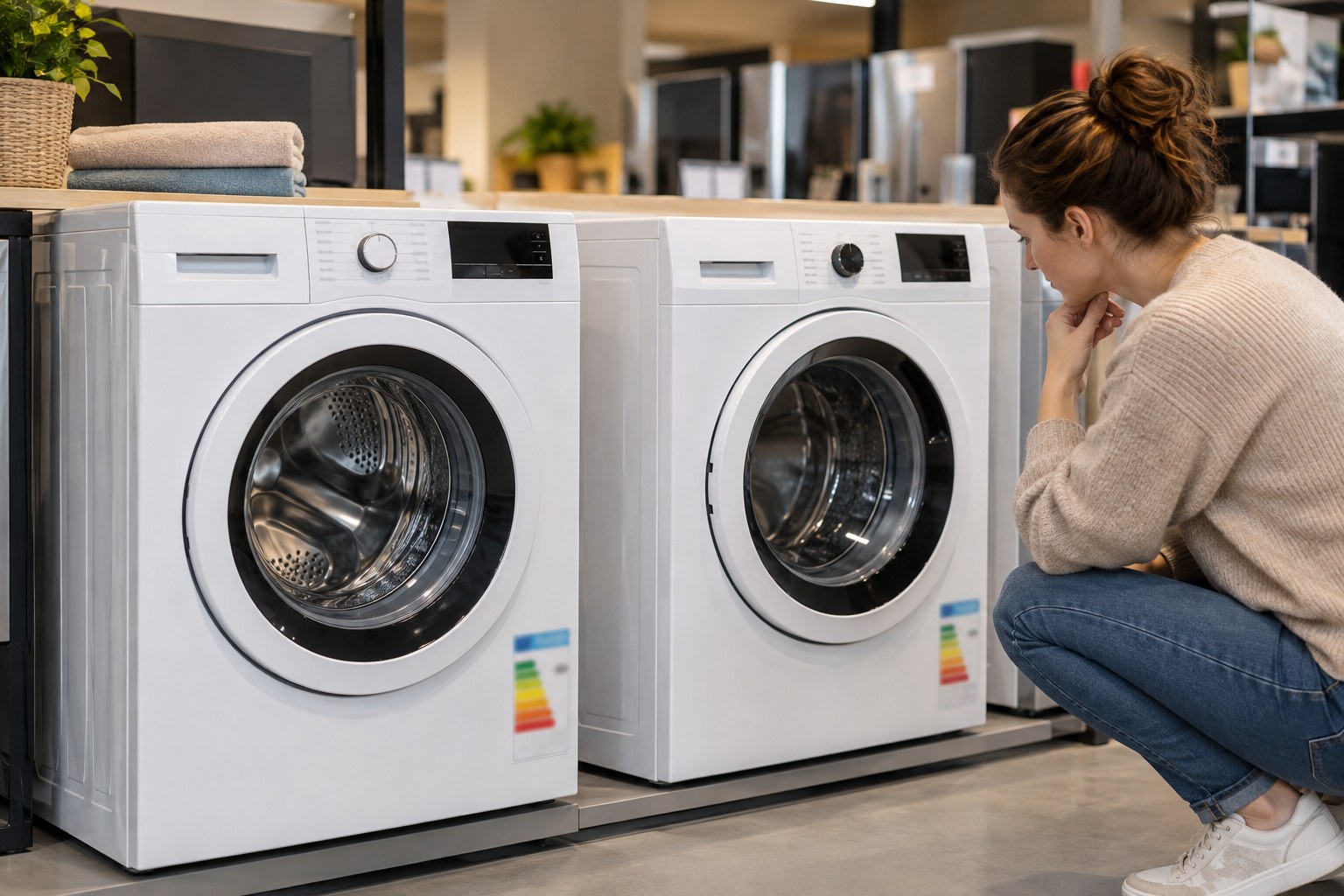
An energy label helps when the products being compared perform the same job. It does not independently establish the appropriate size for your household or how often you will use a programme. Treat the U.S. EnergyGuide estimate as one part of the comparison rather than a complete buying verdict.
Define a fair comparison group
Start with two or three appliances that satisfy the space, capacity and functions you need. A very small machine may show low absolute consumption but require a second cycle for your load. A large machine may carry an attractive efficiency rating while still using more electricity than a smaller suitable alternative. Both possibilities need the actual figures and your intended use to assess them.
Compare the same product type as well. A refrigerator, washing machine and display do not become equivalent electricity users because their advertised efficiency sounds similar. Read the units and reference operation. Put the complete labels beside one another instead of relying only on a retailer's efficiency filter.
Check model identifiers. Similar variants may appear together in a listing despite differing characteristics. The label must belong to the version you will order. For a U.S. purchase, use the EnergyGuide label and product documentation for the exact model being sold. Save the relevant details with the offer so the figures remain traceable.
Read the unit and reference programme
Establish whether consumption is expressed annually, per a specified number of cycles or in another unit. A number without its unit cannot meaningfully become a cost estimate. EnergyGuide provides estimated operating information under stated assumptions, rather than a forecast based on your household. That describes a comparison basis, not identical consumption under every possible setting.
Write your anticipated usage beside it. How often will the appliance run? Where several modes are available, consider the one you expect to use most. If dependable figures for that mode are unavailable, leave the limitation visible. An estimate should not be presented as a measured characteristic of the product.
Use a small calculation with clear assumptions
Suppose two suitable appliances differ by 30 kWh under your assumed annual use. At an explicitly assumed electricity price of $0.35 per kWh, that would be $10.50 a year. These are invented example figures, not a current tariff. Substitute your contract price and the actual consumption information before drawing a purchase conclusion.
If the lower-consumption option costs $100 more in that example, this does not establish a guaranteed payback date. Service life, electricity prices and usage may change. Simple division shows a mathematical period under constant conditions; it does not promise the machine will operate unchanged for that long or that prices will remain fixed.
Show at least an ordinary-use and a lower-use case. When only a few cycles are expected annually, a modest consumption difference matters less than with intensive operation. That can change how the premium looks without disputing the efficiency rating itself. Keeping the assumptions alongside the arithmetic makes the conclusion easier to revisit later.
Notice the other information
Other product specifications may cover noise, water consumption or cycle duration; do not assume these are all shown on the EnergyGuide label. Check the details actually present for the category rather than expecting every label to contain the same measures. A long programme can affect your day even when its electricity figure looks favourable. Sound may make an appliance unsuitable for an open living area regardless of its efficiency claims.
Finally, separate three questions: does the appliance perform the required task, what running costs follow from reasonable assumptions, and which characteristics matter in daily use? The label supplies some of the evidence. Dimensions, access, parts and purchase price complete the picture. This approach selects an efficient appliance because it carries out the needed work under suitable conditions, rather than because a headline rating appears reassuring. It also prevents a superficially economical but incorrectly sized machine from winning a comparison it should never have entered.
Keep a copy of the compared label and date the price information. If an offer changes later, check whether only its price or also its model version has changed. This small record prevents an earlier comparison from being silently reused for different equipment. Store your own usage assumption beside the technical figures as well, so the basis of the calculation remains visible.