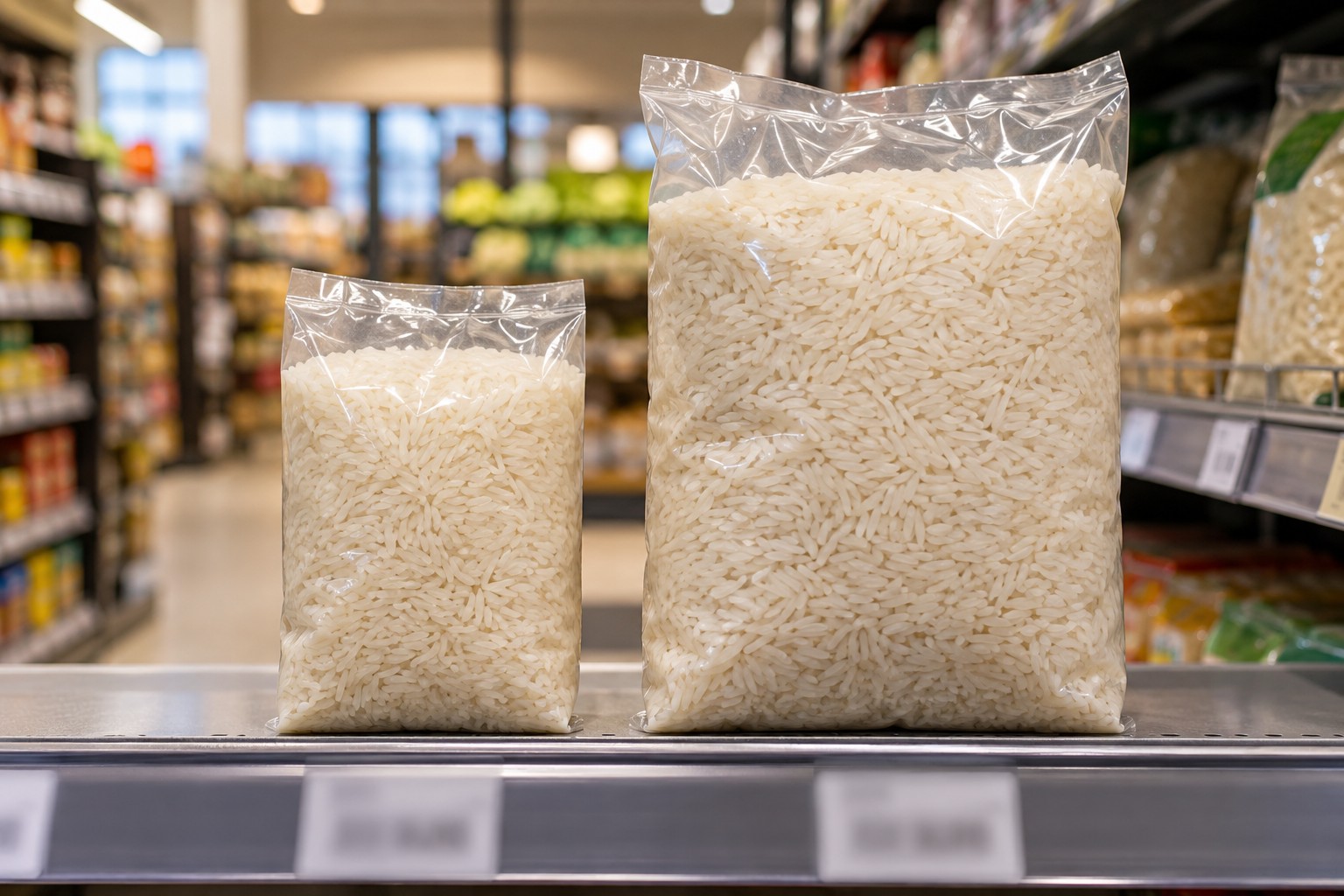
Two packs sit beside one another: one has the lower price, while the other contains more. The shelf price raises two different questions. What will you pay today, and how much product will that payment buy? A unit price helps with the second question. Germany's Verbraucherzentrale explains that it expresses a price for a common quantity, such as a kilogram or litre, so different pack sizes can be compared.
Start with products that can do the same job. A jar of prepared pasta sauce is not simply an equivalent quantity of canned tomatoes. Ingredients and preparation differ. Someone making dinner can compare the complete meal options, but the price per kilogram alone will not describe that decision.
Put both packs on the same scale
For equivalent products, read the quantity and selling price together. Check that the shelf label belongs to the exact size and variety you are holding. A misplaced label can make a careful calculation meaningless.
Consider an invented example: a 500 gram pack of rice costs $1.40 and a one kilogram pack costs $2.60. The smaller pack works out at $2.80 per kilogram. The larger pack therefore costs less for the same quantity, although buying it requires another $1.20 at the checkout. These are illustrative numbers, not current offers.
To calculate a unit price yourself, divide the selling price by the quantity expressed in the chosen unit. For a price per litre, 750 millilitres becomes 0.75 litres. Do not divide one price by grams and another by kilograms and then compare the answers. A note on your phone can hold the calculation while you check the next product.
Think about the portion that gets used
A low unit price is less useful when some of the purchase remains unused. Before choosing the large pack, identify the meals or other uses planned for it. Check the cupboard space, whether the household regularly buys that variety and whether the quantity fits your routine.
Products containing liquid, peel or other material you will not use in the same way can need another step. Read the individual packaging and compare similarly prepared products where possible. Do not silently use drained weight for one item and total contents for another. Your own kitchen calculation should be consistent even when the packages present several different quantities.
Keep the checkout total in the decision
Someone needing a small amount does not have to buy the biggest package. The lowest price per unit and the smallest outlay today can point to different choices. For a one-off baking project, a small pack may fit the actual need even when its kilogram price is higher.
Keep a short record for a few items you buy regularly: the product, quantity, amount you actually paid and date. A complete database is unnecessary. Three or four cupboard staples can be enough to establish the habit. Recording the date also prevents an old purchase price from being mistaken for an available offer.
At the shelf, answer three questions separately. Which equivalent product costs less per common unit? What quantity will be used? What total fits this shopping trip? Putting those answers together is more useful than treating the largest package as an automatic bargain.