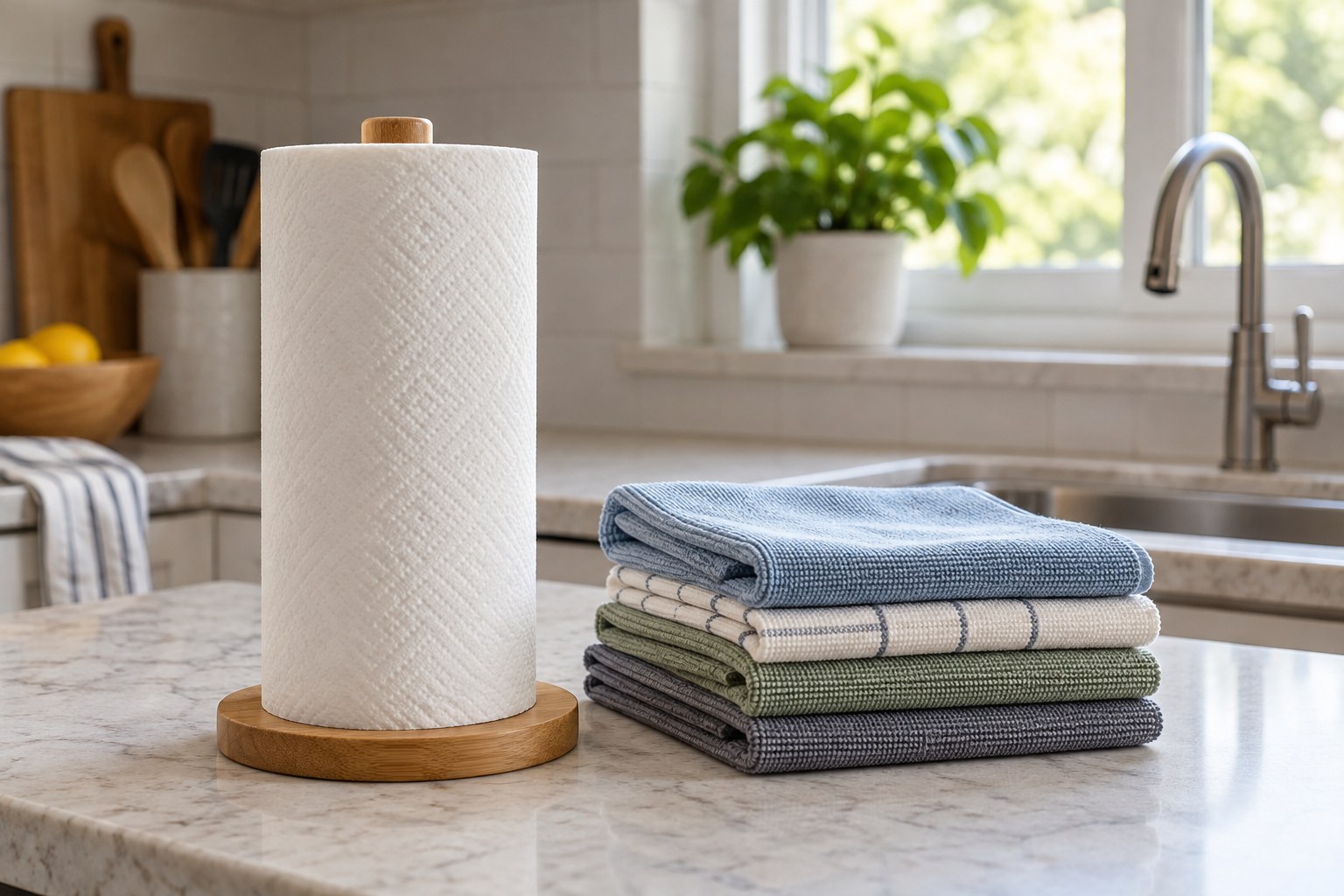
A roll of paper towels and a stack of cloths do not perform exactly the same job in every situation. Rather than making a universal either-or choice, divide the tasks that actually occur at home. What happens to the material after wiping is part of the decision too.
Start with simple recurring jobs: a little water on a worktop, dust on an appropriate furniture surface or drying a cleaned area. Check the care information for both the surface and the cloth. A more abrasive material is not automatically preferable because it feels more substantial.
Reuse requires a routine
Reusable cloths need a place for clean supplies, a clear separation for used items and appropriate cleaning according to their instructions. If damp cloths regularly end up abandoned around the kitchen, the routine is not yet resolved. Buying more will not by itself solve the storage and drying problem.
Distinguishing cloths by task can help. Different colours may work if everyone in the household understands them. Colour does not clean anything, however, and it does not replace appropriate care. Where a task has particular hygiene requirements, follow the relevant guidance rather than treating a general purchasing article as sufficient.
Consider how often the cleaning cycle actually happens. An enormous supply may be unnecessary, while too few cloths can encourage reusing an unsuitable one. The useful number follows from demand and a dependable washing routine.
Compare consumables on a consistent basis
Paper towel rolls vary in length, sheet count and sheet size. A price per roll can therefore mislead. Read the package details and consider the format needed for ordinary jobs. Extra layers or larger sheets do not automatically tell you how much your household will use.
Cloth care belongs in the cost comparison. There is no need to invent a standard washing cost. First establish whether additional laundry is created or whether the cloths can, according to their instructions, join an appropriate load already planned.
A limited combination can be more manageable than replacing everything at once. Observe where existing cloths work and where a different material is needed. Buy the missing tool for that task. A large assortment does not solve a problem that has not yet been identified.